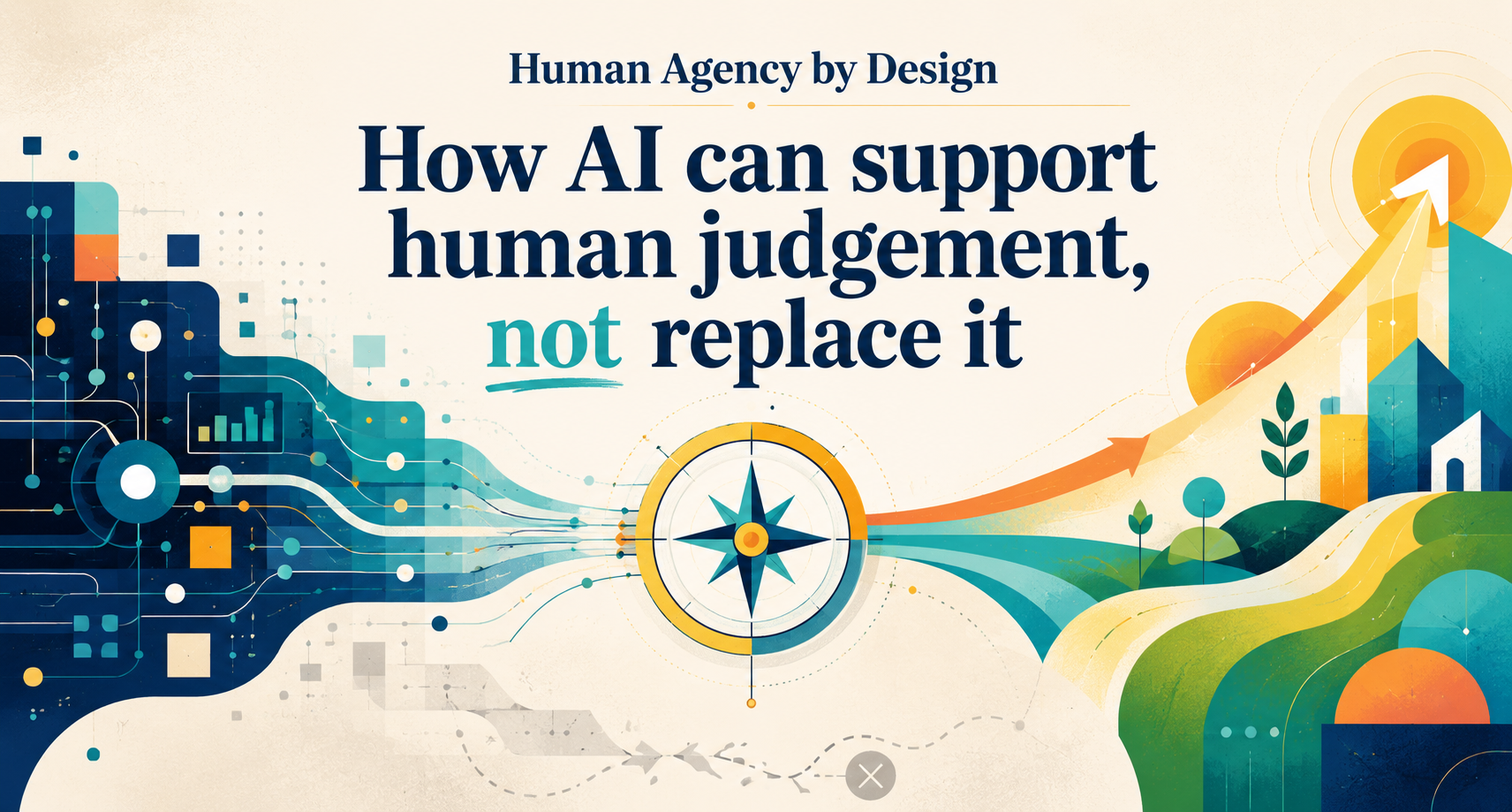

Perhaps the greatest capability of human being of the AI era will not be mastering intelligent technologies, but developing the wisdom to ensure that humans and AI evolve together for the benefit of society.
For decades, career development has largely been viewed as an individual journey. We encourage people to discover their interests, develop their skills, acquire qualifications, build networks, and pursue meaningful work. While these remain essential, they are no longer sufficient.
Today, Artificial Intelligence (AI), automation, digital platforms, intelligent agents, and algorithmic decision-making are reshaping almost every aspect of human life. They are changing how we learn, communicate, work, create, govern organizations, access healthcare, participate in communities, and even form personal relationships.
Consequently, career development can no longer be understood solely as the interaction between an individual and the labour market. It has become a fundamentally socio-technical phenomenon.
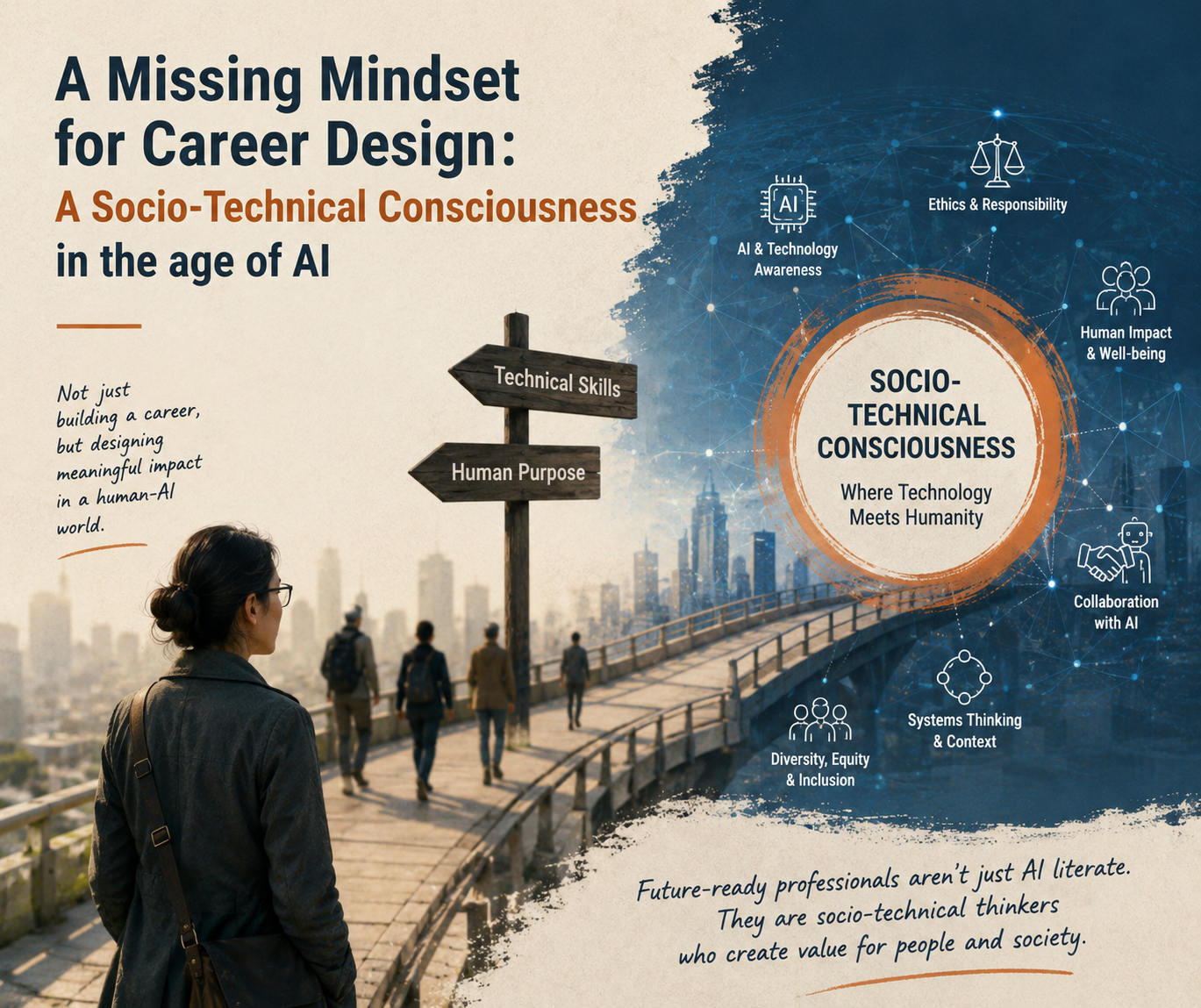
I believe that every individual, irrespective of profession, should cultivate what I call Socio-Technical Consciousness—the ability to understand how technology and society continuously influence each other, and how one’s career decisions should be made within this evolving human-technology ecosystem.
Career success in the AI era will increasingly depend not only on what we know or what technical tools we can use, but also on how well we understand this broader socio-technical reality.
Throughout history, major technological revolutions have transformed societies, institutions, and professions. But, unlike earlier technologies that primarily automated physical work or information exchange, AI increasingly participates in decision-making, knowledge creation, learning, communication, creativity, and social interaction. AI systems are becoming collaborators, advisors, tutors, recruiters, companions, and organizational actors rather than merely computational tools. Artificial Intelligence is transforming far more than jobs. It is reshaping education, healthcare, business, governance, communication, relationships, and even how we make decisions.
As AI becomes embedded in everyday life, it is no longer sufficient to think about careers only in terms of interests, qualifications, or technical skills. We need a new mindset. I call it Socio-Technical Consciousness.
For many years, career development has focused on questions such as:
These remain important. But in the age of AI, they are no longer enough. Today’s professionals must also ask:
These are not merely technical questions. They are socio-technical questions.
Traditional engineering often focused on solving technical problems. Consider the example of building a bridge. Earlier, the engineer’s primary challenge was structural stability, materials, safety, and cost.
But, today’s challenges are no longer purely technical. An engineer designing AI- agents in the context of supply-chain management needs to consider how AI agents can responsibly coordinate and co-exist with the social system of the organization. Similarly, educators, psychologists, managers, doctors, lawyers, and career counsellors can no longer ignore technology. Their work increasingly depends on understanding how humans and intelligent systems interact. Technology has become inseparable from its social consequences.
The transformation is equally significant for professionals in the humanities and social sciences. Psychologists increasingly study human-AI interaction. Educators work alongside intelligent tutoring systems. Career counsellors help clients prepare for occupations transformed by AI. Lawyers address algorithmic accountability. Economists examine labour displacement and digital markets. Sociologists analyse platform societies. Communication experts study AI-generated content. Ethicists debate responsible AI. Development professionals use AI to improve education, healthcare, agriculture, and public services.
In every one of these fields, understanding human behaviour alone is no longer enough. Professionals must also understand how technology shapes that behaviour. Likewise, technologists need a deep appreciation of human values, institutions, culture, ethics, and social systems. The future belongs not to technical specialists or social scientists working independently, but to professionals who can bridge both worlds.
Socio-Technical Consciousness is more than technological literacy. It is an awareness that every technological innovation exists within a larger human ecosystem. It encourages individuals to think simultaneously about:
Someone possessing socio-technical consciousness recognises that adopting AI is never simply about improving efficiency. Every AI application also changes behaviours, expectations, power relationships, learning processes, and institutional cultures. This awareness helps professionals make wiser decisions rather than merely faster ones.
Socio-Technical Consciousness goes beyond AI literacy. Erik Brynjolfsson has argued that the greatest opportunity of AI lies not in replacing people, but in augmenting human capability. Similarly, Yuval Noah Harari reminds us that AI is transforming not merely machines but the very information networks that shape societies, institutions, and human relationships. Together, these perspectives suggest that future-ready professionals need more than technical competence. They need the ability to understand how technology, organizations, and society continuously shape one another. That is precisely what I call Socio-Technical Consciousness—a mindset that enables individuals to design meaningful careers while contributing responsibly to human prosperity.
Much of today’s discussion focuses on AI literacy—learning prompts, mastering tools, or understanding algorithms. These are important starting points. However, true readiness requires something deeper.
We need the wisdom to ask:
These are socio-technical questions. They cannot be answered through technical expertise alone.
Economic development has often been measured through productivity, income, or technological advancement. Yet prosperity is much broader. It includes meaningful work, social inclusion, trust, dignity, lifelong learning, responsible innovation, and the ability of individuals and communities to thrive together.
If AI is to contribute to genuine human prosperity, society must cultivate professionals capable of thinking beyond technical optimisation. Socio-technical consciousness enables individuals to align technology with human values rather than allowing technology alone to dictate social change. It encourages us to ask not simply, “Can AI do this?” but “Should it?” and “How can it be designed to strengthen human capability and collective well-being?”
Career development has entered a new era. Future-ready professionals will certainly require technical competence. But they will also need ethical judgement, systems thinking, interdisciplinary collaboration, contextual understanding, adaptability, and a commitment to responsible innovation.
Career design is therefore no longer only about choosing a profession. It is about designing one’s role within an increasingly interconnected socio-technical world. Developing socio-technical consciousness may become one of the most important capabilities of the twenty-first century—not only for career success, but for building a society in which AI serves humanity responsibly and meaningfully.
Perhaps the defining question for future professionals is no longer: “Which AI tools should I learn?” Instead, it is: “How can I use technology to create meaningful value for people, organizations, and society?”
Perhaps the greatest capability of human being of the AI era will not be mastering intelligent technologies, but developing the wisdom to ensure that humans and AI evolve together for the benefit of society.
Brynjolfsson, E. (2022). The Turing Trap: The promise and peril of human-like artificial intelligence. Daedalus, 151(2), 272–287.
Floridi, L., & Cowls, J. (2019). A unified framework of five principles for AI in society. Harvard Data Science Review, 1(1). https://doi.org/10.1162/99608f92.8cd550d1
Harari, Y. N. (2024). Nexus: A brief history of information networks from the Stone Age to AI. Random House.
Nestor Maslej, Loredana Fattorini, et al. “The AI Index 2025 Annual Report,” AI Index Steering Committee, Institute for Human-Centered AI, Stanford University, Stanford, CA, April 2025. https://doi.org/10.48550/arXiv.2504.07139
Trist, E. L. (1981). The evolution of socio-technical systems. Ontario Quality of Working Life Centre.
Winner, L. (1980). Do artifacts have politics? Daedalus, 109(1), 121–136.
Socio-Technical Consciousness is the ability to understand how technology, people, organizations, and society continuously influence one another. In the age of Artificial Intelligence, career success depends not only on technical skills but also on understanding the broader social, ethical, organizational, and human implications of AI. Developing this mindset enables professionals to make more responsible decisions, collaborate effectively with AI, and contribute to meaningful human prosperity.
AI literacy focuses on understanding AI technologies, tools, and their applications. Socio-Technical Consciousness goes much further. It encourages individuals to examine how AI affects workplaces, education, healthcare, governance, human relationships, ethics, and society as a whole. While AI literacy helps people use AI, Socio-Technical Consciousness helps them use AI responsibly and purposefully within complex human systems.
Modern careers are shaped not only by personal interests and professional skills but also by rapid technological change. Artificial Intelligence is transforming job roles, organizational structures, workplace collaboration, and decision-making processes. A socio-technical approach to career design helps professionals anticipate these changes, adapt continuously, and create meaningful value through responsible human–AI collaboration rather than simply responding to technological disruption.
Socio-Technical Consciousness is valuable across all professions—not only for engineers or AI specialists. Educators, managers, healthcare professionals, entrepreneurs, career counsellors, policymakers, social scientists, psychologists, lawyers, public administrators, and development practitioners all increasingly work in environments where AI influences human decisions and interactions. Understanding this relationship is becoming a core professional capability.
Developing Socio-Technical Consciousness requires more than learning AI tools. Individuals should cultivate systems thinking, ethical reasoning, interdisciplinary learning, digital awareness, and an understanding of how technology affects organizations and society. Practical experience in using AI for real-world problem solving, combined with continuous reflection on its human and social impact, helps professionals build this capability. Within the broader framework of AI Capability Development, Socio-Technical Consciousness complements technical AI skills, human judgment, and purposeful decision-making.
[This article is part of my ongoing work on AI Capability Development and Purposive AI, where I explore how individuals and societies can thrive through responsible human–AI collaboration.
To know more, connect me at: Center for Career and Life Design Counselling]