
Career counselling in the AI era extends beyond helping individuals choose careers. It involves developing AI Capability, continuous learning, career adaptability, and human-AI collaboration so that students and professionals can continuously redesign meaningful careers in an AI-enabled world. This article introduces the concept of AI Career Readiness Score (ACRS) as a proposed framework for assessing preparedness for future careers.
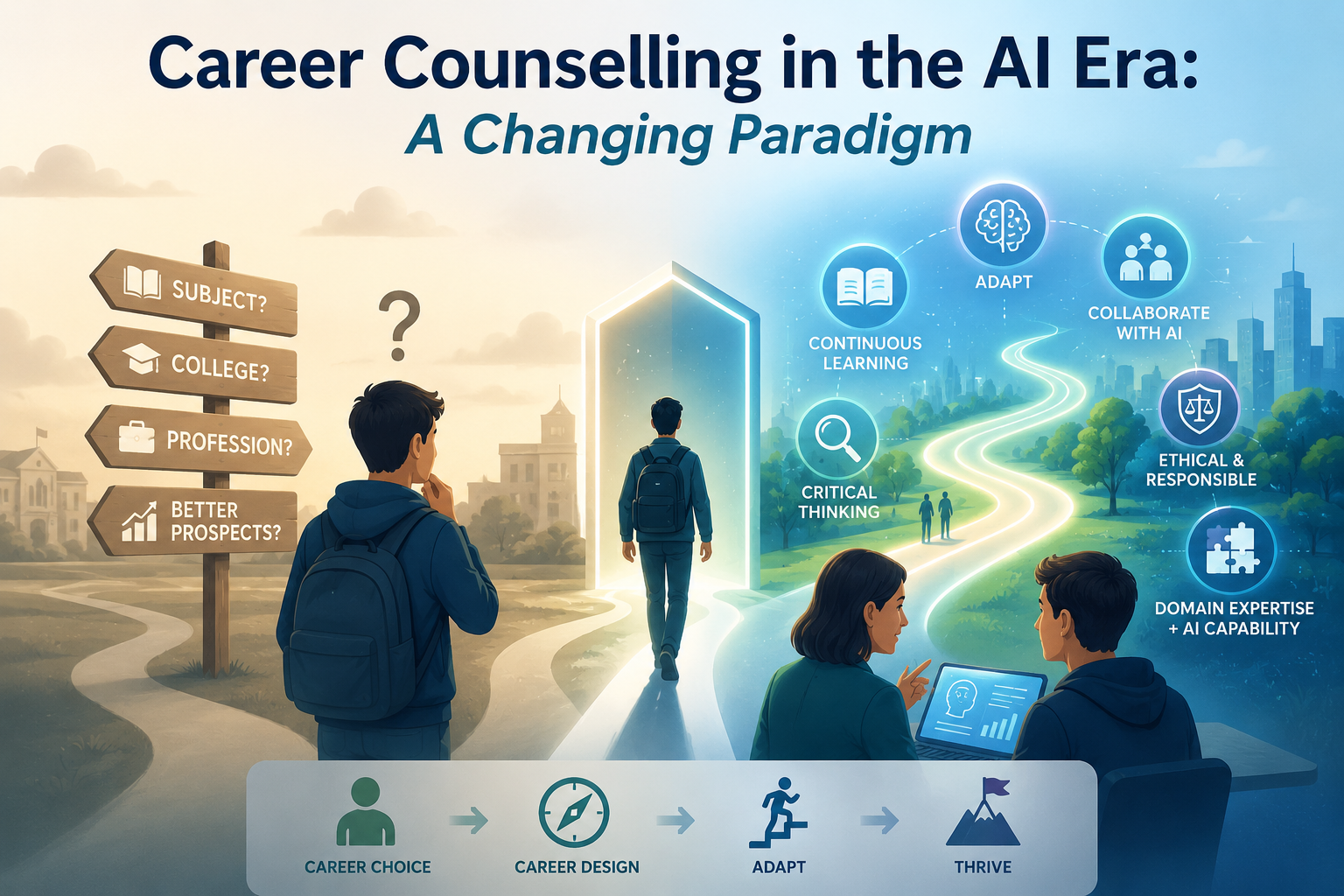
For decades, career counselling has primarily focused on helping individuals answer questions such as:
These questions remain important. However, they are no longer sufficient. Today, AI is transforming virtually every profession—not only software engineering, but also accounting, law, medicine, education, marketing, journalism, finance, design, and even scientific research. Increasingly, the question is no longer “Which career should I choose?” but “How will AI reshape the career I choose?” This requires a fundamental shift in the way we think about career counselling.
Traditional career counselling has often been viewed as a process of matching individuals with suitable occupations based on interests, aptitude, personality, or academic performance. While these remain valuable, career decisions today must also consider a new dimension: How prepared is the individual to continuously learn, adapt, and collaborate with AI throughout his or her career?
In other words, career counselling is gradually evolving from helping people choose a career to helping them design a sustainable career in an AI-enabled world.
Much of today’s discussion focuses on AI literacy—learning ChatGPT, prompt engineering, or AI tools. These are undoubtedly useful. However, the real challenge lies elsewhere.
Using AI effectively is not simply about knowing which tool to use. It requires understanding:
This broader capability may be described as AI Capability.
I define AI Capability as:
The ability to purposefully integrate AI into learning, work, decision-making, creativity, and problem solving while exercising appropriate human judgment, ethical responsibility, and domain expertise.
Notice that this definition is not technology-centric. It is human-centric. The emphasis shifts from AI tool usage to how to work effectively with AI.
If AI Capability is becoming an important determinant of future career success, then an obvious question arises: How do we assess an individual’s preparedness?
One possible approach is the development of an AI Career Readiness Score (ACRS), a conceptual framework that evaluates how prepared an individual is to thrive in an AI-enabled professional environment. Unlike conventional psychometric tests, ACRS would not measure IQ, personality, or aptitude alone. Instead, it could examine dimensions such as:
The objective is not to predict which jobs will disappear. Rather, it is to understand how individuals can continue to create value as professions evolve. At present, ACRS should be viewed as a proposed conceptual framework that requires further theoretical development and empirical validation.
Career counselling in the AI era can no longer stop at recommending subjects, colleges, or professions. It should help individuals explore questions such as:
These questions shift career counselling from a one-time decision to a lifelong process of learning, adaptation, and purposeful growth. Perhaps the future of career counselling is not merely helping people find the “right career.” It is helping them develop the capability to build meaningful careers in an AI-enabled society.
At the Center for Career and Life Design Counselling, we are exploring how career counselling can evolve beyond career choice to AI-enabled career design. Through counselling, workshops, and ongoing research, we seek to help students and professionals develop the capabilities needed to thrive in an AI-enabled world.
Traditional career counselling focused on helping individuals choose suitable subjects, colleges, and professions. In the AI era, career counselling is evolving into a lifelong process of helping people develop the capabilities to continuously learn, adapt, collaborate with AI, and redesign their careers as technologies and industries change.
AI Capability is the ability to purposefully integrate Artificial Intelligence into learning, work, decision-making, creativity, and problem-solving while exercising human judgment, ethical responsibility, and domain expertise. It goes beyond simply using AI tools and has become an essential capability for long-term career success in an AI-enabled world.
AI literacy focuses on understanding AI concepts and learning how to use AI tools such as ChatGPT or other generative AI applications. AI Capability is broader. It includes knowing when to use AI, critically evaluating AI-generated outputs, integrating domain knowledge with AI, collaborating effectively with AI, and continuously adapting as technologies evolve.
The AI Career Readiness Score (ACRS) is a proposed conceptual framework for assessing how well an individual is prepared to thrive in an AI-enabled professional environment. It considers dimensions such as AI awareness, career adaptability, critical thinking, human-AI collaboration, ethical AI use, creativity, continuous learning, and integration of domain expertise with AI.
Preparing for future careers requires more than selecting the right degree or learning AI tools. Individuals should develop strong domain expertise, cultivate continuous learning habits, strengthen critical thinking and problem-solving skills, understand AI’s impact on their profession, and learn how to work effectively and responsibly with AI throughout their careers.
Brown, D., & Lent, R. W. (Eds.). (2020). Career development and counseling: Putting theory and research to work (3rd ed.). John Wiley & Sons.
Luckin, R. (2018). Machine learning and human intelligence: The future of education for the 21st century. UCL Institute of Education Press.
Mollick, E. (2024). Co-intelligence: Living and working with AI. Portfolio.
Savickas, M. L. (2013). Career construction theory and practice. In S. D. Brown & R. W. Lent (Eds.), Career development and counseling: Putting theory and research to work (2nd ed., pp. 147–183). John Wiley & Sons.
World Economic Forum. (2025). The Future of Jobs Report 2025. World Economic Forum.