
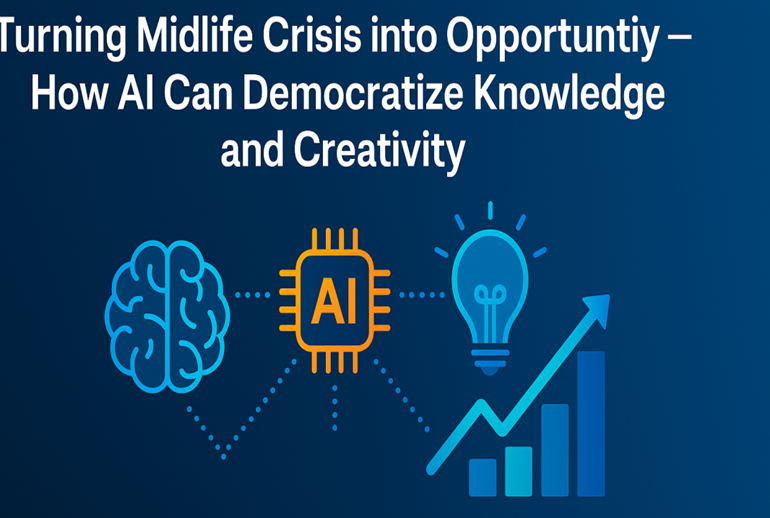
Instead of viewing midlife as a time of crisis, it can be reframed as a period of significant transition and self-discovery, a “midlife awakening” where individuals re-evaluate their lives and goals. This shift in perspective acknowledges the challenges but also highlights the potential for growth, self-acceptance, and a renewed sense of purpose.
It’s true that happiness tends to hit a low point in the mid-to-late 40s for many people, as careers plateau and life’s responsibilities peak. Yet psychologists and experts now argue that midlife doesn’t have to be a period of decline – it can be a period of positive transition and renewal. In fact, research shows that many adults hit a creative stride in midlife, with brains especially good at making connections and solving problems in novel ways.
One reason midlife can spark renewal is that by our 40s and 50s we’ve accumulated a wealth of experience and crystallized intelligence – the deep well of knowledge and pattern-recognition built over decades. Studies find that as people age, they grow less self-conscious and more confident, which frees them to try new things without fear of embarrassment.
Psychologist Erik Erikson famously described midlife as the stage of “generativity” – a drive to be creative, productive, and contribute to society, rather than stagnating. In other words, many mid-career adults are hungry for fresh meaning and creative engagement in their work and personal lives. With the right mindset, what used to be seen as a midlife crisis can become a midlife renaissance of learning and creativity.
While mid-career professionals today may have finished their formal education long before the age of artificial intelligence, the AI revolution has now arrived on their doorstep – and it’s changing everything. The widespread adoption of generative AI tools (which create content like text, images, or code) truly took off around 2022 with the debut of tools like ChatGPT. In the years since, businesses in every sector have begun integrating AI at lightning pace, triggering disruptions comparable to past industrial revolutions.
For midlife professionals (say, 40s, 50s and above), this rapid shift can feel daunting. In a recent multi-country survey, only about 15% of workers aged 45–65 reported that they currently use AI in their jobs. Many experienced workers aren’t sure how these tools fit into their work routines. In fact, people over 40 in white-collar roles are considered most at risk of job disruption if they don’t upskill, since AI could automate parts of roles from accounting to marketing. These realities might feed a sense of “career crisis” for some midlifers – a fear of being left behind by the AI wave.
But here’s the flip side: mid-career professionals who do embrace AI are finding it can amplify their potentials. Those older workers who have adopted AI tools tend to be self-taught power users, proving that you can learn new tech tricks in midlife. Forward-thinking organizations and even governments are beginning to support this transition. For example, Singapore recently offered every citizen over 40 grants to refresh skills, with huge uptake in AI and IT courses. The message is clear: it’s never too late to learn AI, and doing so can turn a mid-career slump into an opportunity. Seasoned experience paired with new AI skills is a winning combination – in fact, one report calls this “the winning combination of experience and skills” for staying employable and impactful. Far from making them obsolete, AI can make workers 45+ into invaluable assets if they’re willing to adapt and grow.
The exciting news is that artificial intelligence isn’t just about automation – it can also be a catalyst for creativity and personal growth, especially for those in midlife. Recent studies on AI-assisted creativity reveal a promising trend: AI can generate a high volume of ideas and even help less-experienced creators punch above their weight, but the best results occur when humans and AI collaborate. For example, in one analysis of creativity research, AI (like GPT-4) was able to produce more ideas, and often more original ideas, than most humans in brainstorming tests. AI can also spark inspiration by producing unexpected, “out-of-the-box” outputs – one study showed people generated 18% more ideas when first shown AI-generated art, because the AI’s odd twists expanded their thinking. Perhaps most importantly, across 12 different studies, teams that co-created – combining AI’s generative power with human judgment and refinement – consistently produced the most novel and high-quality outcomes. In short, AI is like a prolific creative partner that can flood you with possibilities, while you as the human decide which ideas resonate and shape them with your experience. This symbiosis can especially benefit midlife professionals by jump-starting their creative explorations in areas they might have previously felt stuck or unsure.
Here are a few key ways AI can empower creativity and exploration for mid-career individuals:
For mid-career professionals and academics standing at the crossroads of change, the rise of AI should be seen not as a threat but as a timely ally. Yes, the technology is disruptive – it’s automating tasks and shifting job requirements – but it’s also democratizing creativity and knowledge in ways we’re only beginning to appreciate. The key is to approach AI with curiosity and an open mind. Much like learning to use a personal computer or the internet in decades past, embracing AI is now a new facet of lifelong learning. The good news is that midlife adults are absolutely capable of this learning – in fact, the combination of emotional maturity, professional experience, and now AI augmentation can make the second half of one’s career extraordinarily rich.
To harness this potential, consider a few steps:
1. Adopt a Growth Mindset: Your brain is capable of growth at any age. Remember that many older workers who dive in become adept power users of AI. You can be one of them.
2. Learn the Tools: Start with accessible AI tools relevant to your field or interests. For writing and brainstorming, experiment with a chatbot like ChatGPT or Bing. If you’re curious about visual art or design, try a free image generator. There are AI-driven assistants for coding (e.g. GitHub’s Copilot), for music composition, for language learning – and many have user-friendly interfaces. You don’t need a degree in computer science; you just need some practice and a willingness to ask questions. Leverage free tutorials and communities (there are plenty geared towards beginners and mid-career learners).
3. Integrate AI into Your Workflow Gradually: Identify one or two repetitive or challenging tasks in your job or projects that an AI might help with. It could be drafting a report outline, analyzing a dataset, or generating ideas for a lesson plan. Use AI as a support, and then apply your expertise to review and refine the output. Over time, you’ll develop intuition for where AI adds value for you, and you’ll build confidence in using it. Your productivity may get a boost – possibly freeing time to focus on more creative or strategic aspects that you truly enjoy.
4. Stay Ethical and Adaptable: Using AI holistically also means being mindful of its limitations. Always double-check AI outputs for accuracy, especially in professional settings. Use AI as an aid, but continue to develop your own judgment and skills. And remain adaptable – the tools will evolve quickly. What’s important is your agility in learning and the creative mindset you bring. Midlife professionals have an advantage here: you’ve weathered technology changes before, and you can do it again, blending wisdom with agility.
Yes, midlife can be a time of renewal, and AI can absolutely help make it happen. Academic findings and real-world examples align on this: we don’t lose our creative potential after 40 – if anything, we gain new dimensions to it. AI is simply a powerful new instrument we can play in the orchestra of our midlife reinvention. By rethinking midlife as a phase of exploration, growth, and creativity, and by adding AI tools to our toolkit, we can transform what might have been a crisis into an opportunity.
1. Blanchflower, David G. (2020). Unhappiness and age. Journal of Economic Behavior & Organization, Volume 176, 2020,Pages 461-488,ISSN 0167-2681. https://doi.org/10.1016/j.jebo.2020.04.022
2. Harmon, J., & Lee, K. “Jerry.” (2024). Midlife “crisis” or midlife awakening? Leisure as obstacle or opportunity. World Leisure Journal, 67(2), 201–210. https://doi.org/10.1080/16078055.2024.2413066
3. World Economic Forum. (2025). Future of Jobs Report. Retrieved from https://www.weforum.org/publications/the-future-of-jobs-report-2025/
4. McKinsey & Company. (2023). Generative AI and the future of work in America. Retrieved from: https://www.mckinsey.com/mgi/our-research/generative-ai-and-the-future-of-work-in-america
5. Forbes (2024). Embracing The Power Of Human And AI Collaboration To Create New Opportunities. Retrieved from https://www.forbes.com/sites/sap/2024/09/10/embracing-the-power-of-human-ai-collaboration-in-cloud-erp/
6. O’Toole, Katherine and Emőke-Ágnes Horvát (2024).Extending human creativity with AI. Journal of Creativity, Volume 34, Issue 2,2024. Retrieved from https://doi.org/10.1016/j.yjoc.2024.100080
7. Singapore SkillsFuture Initiative. (2024). Empowering every Singaporean to build future-ready skills for fulfilling careers. Retrieved from https://www.skillsfuture.gov.sg
8. Harvard Business Review. (2023). AI Won’t Replace Humans — But Humans With AI Will Replace Humans Without AI. Retrieved from: https://hbr.org/2023/08/ai-wont-replace-humans-but-humans-with-ai-will-replace-humans-without-ai
9. Tucker J. M., Mahdi Srour, and Frank Piller (2024). When Generative AI Meets Product Development. MIT Sloan Management Review. Retrieved from: https://sloanreview.mit.edu/article/when-generative-ai-meets-product-development/
10. Schachter, David (2025). AI as a Writing Partner: Lessons from My Memoir Process. Retrieved from: https://medium.com/@schachterlearningsolutions.com/ai-as-a-writing-partner-lessons-from-my-memoir-process-21538fbe895c