
Artificial Intelligence has become one of the most sought-after skills of the decade. Universities are launching AI courses, organisations are conducting AI workshops, and professionals across industries are rushing to learn ChatGPT, Gemini, Copilot, Claude, Midjourney, and dozens of other AI tools.
Yet, after the initial excitement, an interesting pattern is emerging. Many people complete AI training but struggle to integrate AI meaningfully into their daily work. They know the tools. They understand prompt engineering. They can generate text, presentations, and images.
But AI rarely becomes part of how they actually think, decide, create, or solve problems. Why? Perhaps because we have misunderstood what AI capability really means.
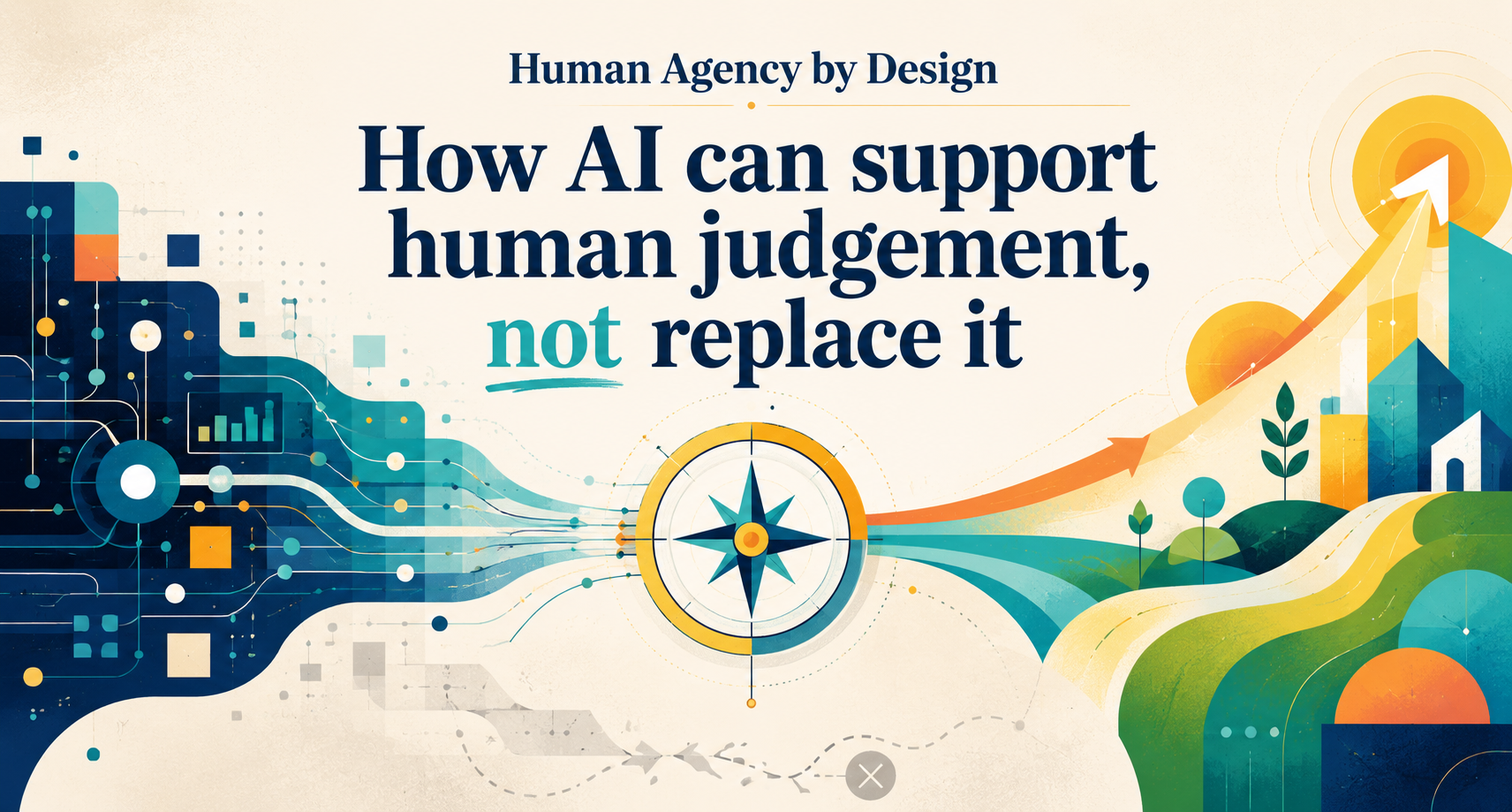
The future of AI adoption may depend less on learning generic tools and more on understanding how AI augments the specific work we do.
Most AI training programmes today follow a remarkably similar structure. Participants learn how to:
These are useful foundational skills. However, they are comparable to learning how to use Microsoft Office. Knowing Word or Excel does not automatically make someone an effective lawyer, researcher, entrepreneur or teacher. Similarly, knowing ChatGPT does not automatically make someone effective in their profession. AI tools are general-purpose technologies. Professional capability is domain-specific. Confusing the two creates an important gap between learning AI and applying AI.
Instead of asking, “Which AI tools should everyone learn?” perhaps we should ask, “How can AI augment the capabilities required for this particular career?”
The difference appears subtle. It is actually transformational. Instead of teaching AI first and hoping people discover applications later, we begin with the work itself. What decisions does this professional make? What information do they process? What problems consume most of their time? Where do they create value?
Only then do we identify where AI can meaningfully assist.
A teacher, a doctor, a journalist, a researcher, a lawyer and a rural entrepreneur may all use the same AI model. Yet the capabilities they need are entirely different. A teacher requires AI to design personalised learning experiences, prepare assessments and provide feedback. A researcher needs AI to search literature, identify knowledge gaps, analyse evidence and generate hypotheses. A lawyer benefits from AI-assisted legal research, drafting and precedent analysis. An entrepreneur may use AI for customer communication, pricing, business planning and marketing. A physician needs AI as a clinical decision support tool while remaining responsible for judgement and patient care.
The technology remains the same. The professional context changes completely. Therefore, effective AI capability cannot be generic. It must be contextual.
AI literacy is essential. Everyone should understand what AI is, what it can do and where its limitations lie. However, literacy is only the first stage. The next stage is AI capability. Capability means integrating AI into one’s professional thinking and workflow. This involves:
Capability is not about mastering hundreds of prompts. It is about redesigning how work gets done.
Imagine developing AI education around career clusters rather than around software. For example: an educator develops capabilities in personalised instruction, assessment design and learner analytics. A healthcare professional focuses on clinical documentation, evidence synthesis and patient communication. A corporate manager develops capabilities in strategic analysis, decision support and workflow optimisation. A researcher learns literature mapping, hypothesis generation, coding support and scientific writing. A rural micro-entrepreneur uses AI to improve product design, pricing, customer communication, inventory planning and market access.
The learning objectives differ. The technology remains largely identical. This represents a shift from tool-centric learning to purpose-centric capability development.
Many organisations currently introduce AI by providing employees with generic AI workshops. While useful, these often fail to produce sustained adoption. Employees return to work unsure where AI actually fits within their daily responsibilities. Instead, organisations could begin by analysing work roles. For each role they might ask:
Only then should AI capability programmes be designed. Such an approach is likely to produce greater productivity and stronger employee engagement than generic AI awareness sessions.
At the Center for Career and Life Design Counselling, our work has always begun with a simple principle: Purpose precedes tools. The same philosophy underpins our initiative, Purposive AI.
Rather than teaching AI as a collection of software applications, Purposive AI seeks to help individuals develop AI capability within the context of their chosen careers, aspirations and life goals. Whether someone is a student preparing for higher education, a working professional navigating career transitions, a teacher redesigning classroom learning, or a rural entrepreneur building a livelihood, AI should become a purposeful partner in human growth—not merely another digital tool.
The objective is not simply to produce more AI users. It is to cultivate professionals who know when, where and how AI can enhance human judgement, creativity and impact.
Artificial Intelligence will undoubtedly become a universal technology. Human work, however, will remain wonderfully diverse. This is why the future of AI education cannot be built on generic prompts and tool demonstrations alone. It must begin with human purpose. It must recognise the unique cognitive demands of different professions. And it must help individuals redesign their work so that AI complements—not replaces—their expertise.
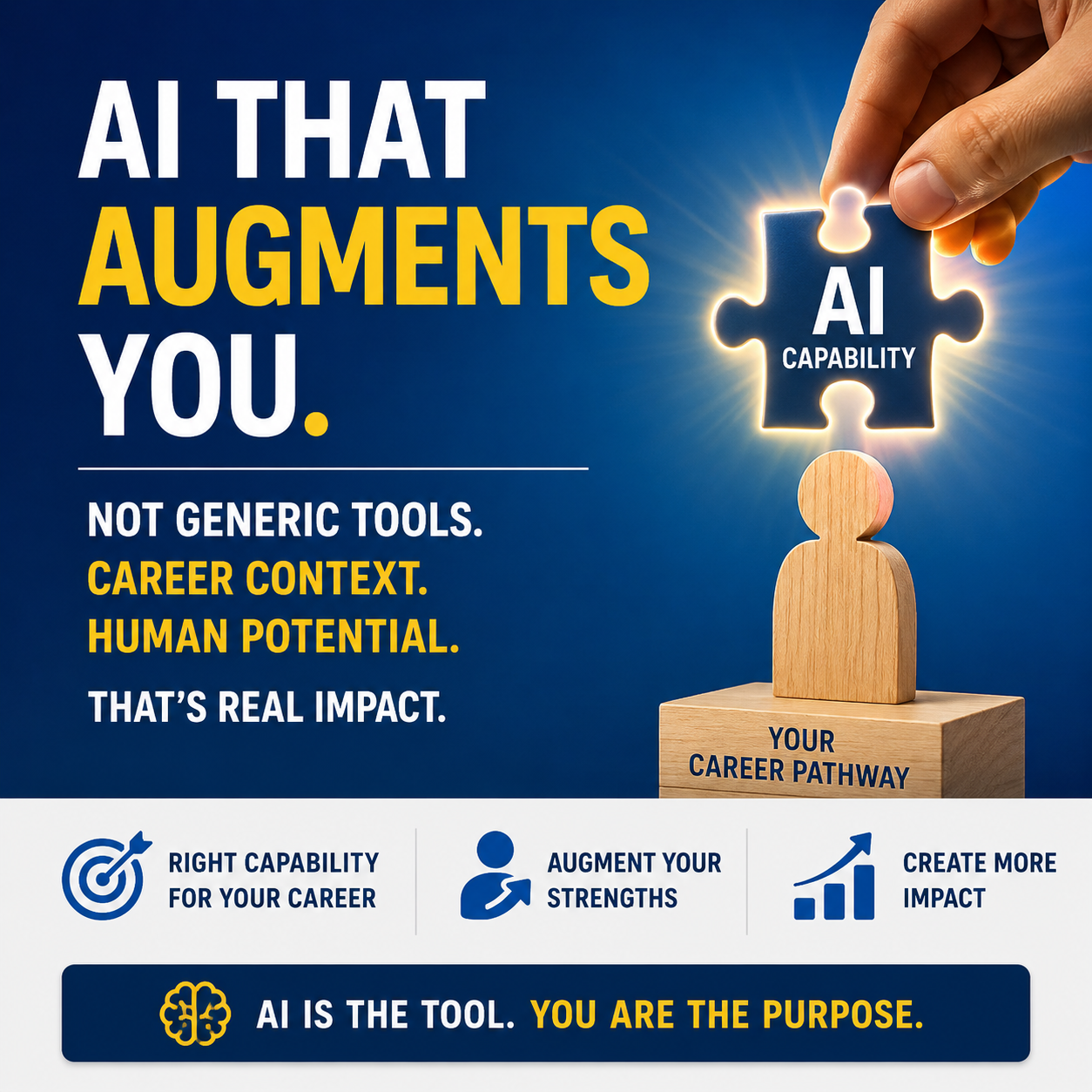
AI capability should be developed in the context of a person’s career pathway—not as a collection of generic prompts and tools, but as a deliberate augmentation of human capability.
No. While everyone benefits from understanding AI fundamentals, the capabilities required by a teacher, lawyer, researcher, entrepreneur or healthcare professional differ significantly. Effective AI learning should be tailored to professional context.
AI literacy refers to understanding AI concepts, tools and limitations. AI capability goes further by integrating AI into professional workflows, decision-making and problem-solving to improve performance and create value.
Many programmes focus on generic tools rather than helping learners apply AI to their specific roles. People adopt AI more effectively when they see clear connections between AI and the real challenges of their work.
Purposive AI is an initiative of the Center for Career and Life Design Counselling that promotes career-specific, purpose-driven AI capability development. It emphasises augmenting human capability by aligning AI with an individual’s profession, aspirations and context.
Organisations should begin by analysing the cognitive tasks, workflows and decision-making requirements of each role. AI training should then focus on how AI can enhance those specific activities rather than teaching generic prompts or software features.
Brynjolfsson, E., Li, D., & Raymond, L. R. (2023). Generative AI at work. National Bureau of Economic Research Working Paper No. 31161.
Davenport, T. H., & Miller, S. (2022). Working with AI: Real stories of human–machine collaboration. MIT Press.
Mollick, E. (2024). Co-Intelligence: Living and Working with AI. Portfolio.
World Economic Forum. (2025). The Future of Jobs Report 2025. Geneva: World Economic Forum.
Wilson, H. J., & Daugherty, P. R. (2018). Collaborative intelligence: Humans and AI are joining forces. Harvard Business Review, 96(4), 114–123.
Prof. Somprakash Bandyopadhyay is Founder & Director of the Center for Career and Life Design Counselling and the creator of Purposive AI, an initiative focused on purpose-driven AI capability development. A former Professor of Information Systems at the Indian Institute of Management Calcutta (2001–2022), he has over four decades of experience in academia, research, consulting and executive education. His current work explores the intersection of career design, life design, human capability development and Artificial Intelligence.