
Across India, conversations around Artificial Intelligence (AI) have become increasingly common. Governments, corporations, universities, and non-profit organizations are investing heavily in AI literacy initiatives. However, much of the current discourse focuses on technology awareness—understanding AI tools, writing prompts, or learning how generative AI works.
While these efforts are valuable, an important question remains: can AI meaningfully improve the livelihoods of rural micro-entrepreneurs and Self-Help Group (SHG) women?
The answer, I believe, is yes—but only if we move beyond conventional AI literacy and focus instead on AI-assisted entrepreneurship and livelihood development.
This position paper proposes a practical framework for achieving that objective.
Many AI literacy initiatives implicitly assume that people need to learn AI before they can benefit from it.
As a result, training programs often focus on:
These topics may be useful for students, professionals, and technology enthusiasts. However, they may not be immediately relevant to a rural woman producing pickles, a kantha artisan, a vegetable seller, or a tailor.
Their questions are different:
For these users, AI is valuable not as a technology to be studied, but as a tool to solve real-life business problems.
The goal should not be: Teach people AI.
The goal should be: Help people learn, create, market, and earn using AI.
This shifts the focus from technology adoption to livelihood outcomes. The framework proposed here is based on a simple principle: AI should function as a business assistant rather than a technical system.
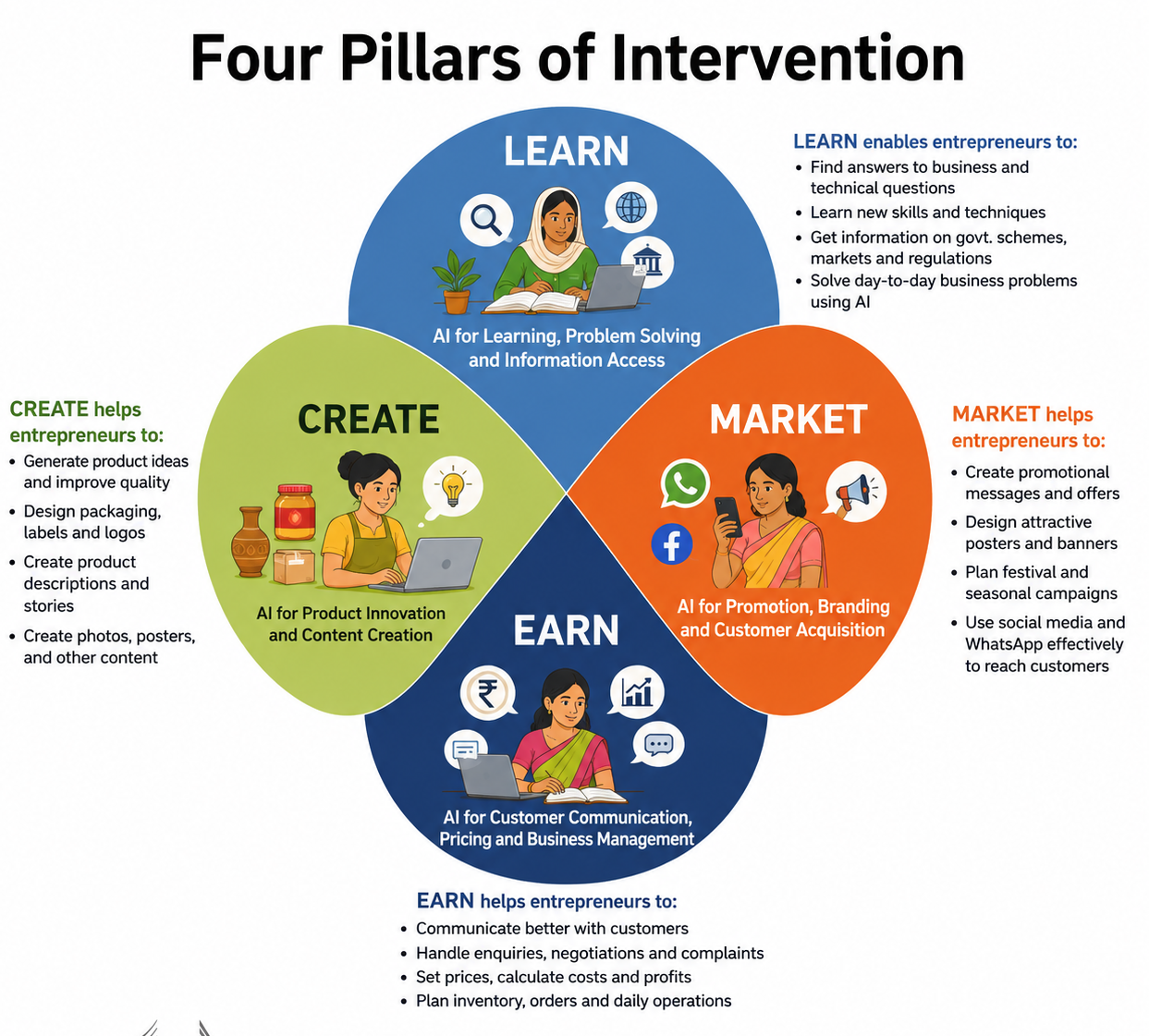
The proposed framework consists of four intervention domains:
AI for Learning, Problem Solving, and Information Access.
Examples:
AI becomes an always-available learning companion.
AI for Product Innovation and Content Creation.
Examples:
AI becomes a co-creator.
MARKET
AI for Promotion, Branding, and Customer Acquisition.
Examples:
AI becomes a marketing assistant.
AI for Customer Communication, Pricing, and Business Management.
Examples:
AI becomes a business manager.
Most rural entrepreneurs do not need sophisticated analytics or advanced automation. What they need are small but meaningful improvements in daily business activities.
For example, a pickle producer may use AI to:
A tailor may use AI to:
A poultry farmer may use AI to:
In each case, AI supports action rather than merely providing information.
Although the intervention framework remains common, implementation should be tailored to enterprise types.
Five sector-specific playbooks are proposed:
Food Producers: Pickles, papad, snacks, spices, bakery products.
Craft Producers: Kantha, dokra, terracotta, bamboo, jute.
Retailers: Grocery stores, vegetable vendors, garment sellers.
Service Providers: Tailors, beauticians, tutors, repair services.
Agri Entrepreneurs: Poultry, dairy, fisheries, mushroom cultivation.
Each playbook would contain:
specific to that sector.
Many discussions on AI focus heavily on prompts. However, prompts are merely operational tools. The real unit of intervention should be the use case.
For example:
Use Case
Generate a WhatsApp Promotion Message.
The use case then contains:
This approach makes AI accessible to low-literate users and community trainers.
India stands at a critical moment. The challenge is no longer whether AI will become part of everyday life. It already has. The real challenge is ensuring that AI benefits not only urban professionals and technology workers but also rural women, artisans, micro-producers, and small entrepreneurs.
This requires a shift: from AI literacy to AI capability and ultimately to AI-assisted livelihood development. The proposed LEARN–CREATE–MARKET–EARN framework offers one possible pathway toward that future. If implemented thoughtfully, AI can become not merely a technology of automation but a technology of empowerment. And perhaps that is where its greatest social impact lies.
European Commission, Organisation for Economic Co-operation and Development, & Code.org. (2025). Four domains of AI literacy. Publications Office of the European Union. https://ailiteracyframework.org/
Organisation for Economic Co-operation and Development. (2024). OECD digital economy outlook 2024. OECD Publishing. https://www.oecd.org
Stanford Institute for Human-Centered Artificial Intelligence. (2025). AI index report 2025. Stanford University. https://hai.stanford.edu/ai-index
UNESCO. (2024). UNESCO AI competency frameworks for students and teachers. United Nations Educational, Scientific and Cultural Organization. https://www.unesco.org
World Bank. (2024). Digital development overview: Technology and economic inclusion. World Bank. https://www.worldbank.org
Bandyopadhyay, S. (2021). Impact of online digital marketplace literacy program on entrepreneurial performance of rural craft producers of Birbhum, West Bengal [Unpublished Project report supported by DST, Govt. of India]. Social Informatics Research Group, IIM Calcutta / Research Project. https://sirg.co.in/
Bandyopadhyay, S. (2026). Purposive AI: A framework for AI-assisted livelihood development among rural micro-entrepreneurs and SHG women [Position paper]. Center for Career and Life Design Counselling. https://purposiveai.com/