
Thirty years ago, career choices were relatively limited.
Today, students encounter hundreds of occupations, emerging industries, interdisciplinary careers, freelancing opportunities, higher education pathways, and rapidly changing skill requirements.
Many students ask:
Paradoxically, more information often leads to greater confusion.
Career planning has become a process of navigating uncertainty rather than simply selecting a profession.
Rahul is a second-year B.Com student in Kolkata.
He performs reasonably well academically but is uncertain about his future.
Some of his classmates are preparing for CAT, while others are considering government jobs, CA, CFA, MBA, banking, analytics, or entrepreneurship.
Rahul feels overwhelmed.
His questions include:
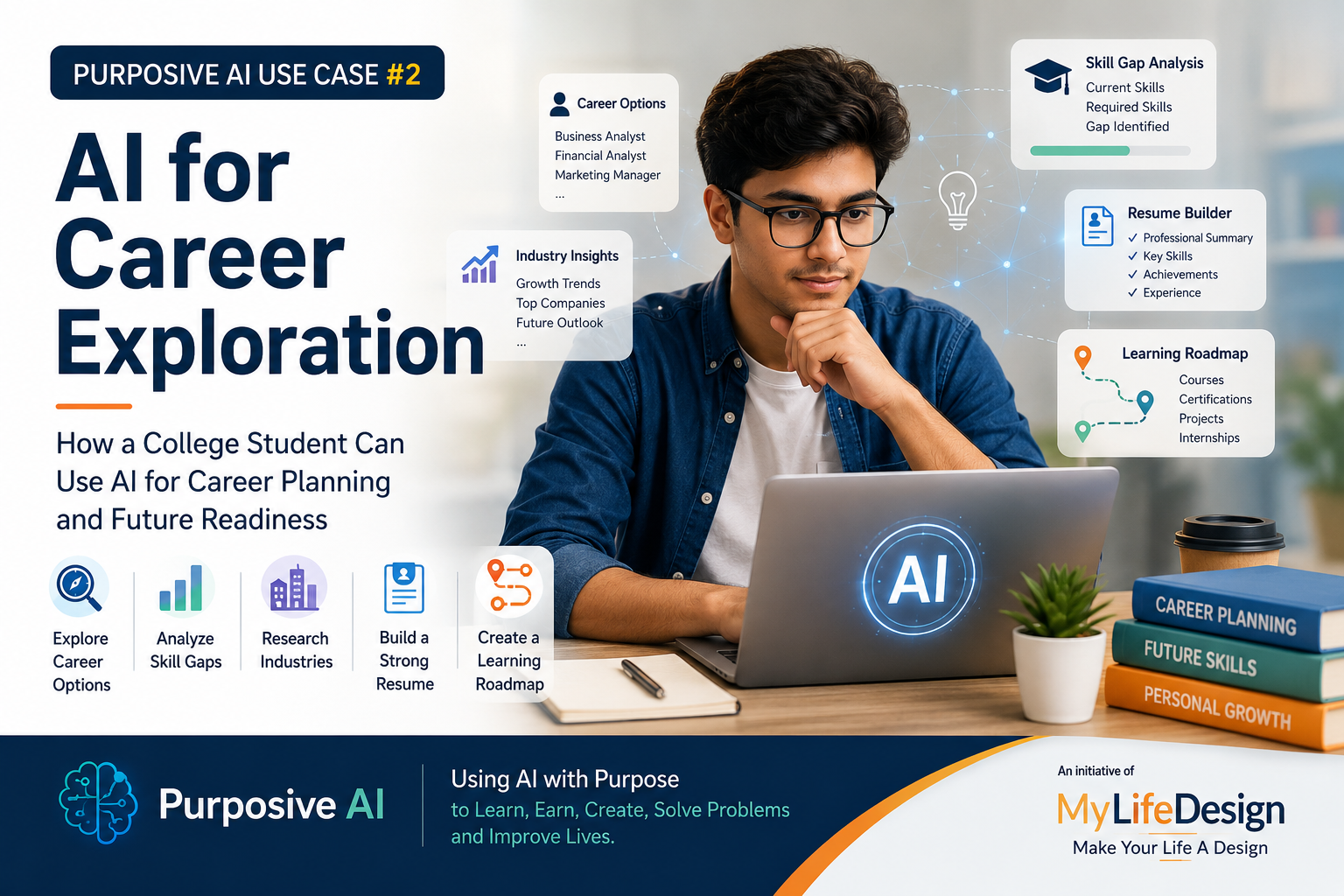
Rather than searching randomly across websites and social media, Rahul decides to use AI as a structured career exploration partner.
The question is not:
Can AI tell Rahul which career to choose?
The more useful question is:
How can Rahul use AI to make better career decisions?
AI cannot discover Rahul’s purpose, values, or aspirations.
However, AI can help Rahul:
Used thoughtfully, AI becomes a career exploration companion—not a career decision-maker.
Challenge
Rahul only knows about a few popular career options.
Example Initial Prompt
“I am a second-year B.Com student interested in business, technology and communication. Suggest ten possible career paths, describing the nature of work, required qualifications and future prospects.”
Expected Output
AI generates:
Benefits
Challenge
Rahul wants to become a Business Analyst but does not know what skills employers expect.
Example Prompt
“Compare my current skills with those required for an entry-level Business Analyst. Suggest the most important gaps and recommend how I can bridge them over the next twelve months.”
Expected Output
AI identifies:
Benefits
Challenge
Rahul hears that “AI is changing every industry.”
He wants evidence rather than opinions.
Example Prompt
“Compare career opportunities in Banking, FinTech, Consulting and Data Analytics for commerce graduates in India. Discuss growth trends, required skills and future opportunities.”
Expected Output
AI provides:
Benefits
Challenge
Rahul has completed a few academic projects and online courses but has never written a professional resume.
Example Prompt
“Help me prepare a one-page resume for summer internships. Highlight my academic projects, leadership activities and transferable skills. I am attaching my draft resume.”
Expected Output
AI suggests:
Benefits
Challenge
Rahul wants to prepare systematically over the next two years.
Example Prompt
“Create a two-year learning roadmap for a B.Com student aspiring to build a career in Business Analytics. Include technical skills, internships, certifications, networking and portfolio development.”
Expected Output
AI develops:
Benefits
AI is a powerful assistant, but students should recognise its limitations.
AI Cannot Choose Your Career
Career decisions depend upon:
These require personal reflection.
AI Cannot Replace Career Counselling
Career counsellors empower students understand their aspirations, interpret assessment results, reflect on interests, understand themselves, and make informed choices.
AI can support—but not replace—this process.
AI May Not Reflect the Latest Industry Information
Students should verify important information using:
AI Cannot Build Your Skills
Learning ultimately depends upon practice, projects and real-world experience.
The future belongs not merely to students who use AI.
It belongs to students who know how to ask better questions, evaluate information critically, and translate insights into action.
Career development is no longer a one-time decision.
It is a continuous learning journey.
AI can become a valuable companion on that journey—but only when used purposefully.
For decades, career guidance focused primarily on helping students choose occupations.
Today, the challenge is much broader.
Students must continuously:
Artificial Intelligence has the potential to transform career development—not by making decisions for students, but by making exploration more personalized, informed, and reflective.
The future of career guidance may therefore involve a partnership:
This is the vision behind Purposive AI: helping people use AI with purpose—to learn, earn, create, solve problems, and improve their lives.
AI can help students explore career options, compare professions, identify skill requirements, and organise information. However, the final career decision should be based on the student’s interests, values, strengths, and aspirations.
Yes. AI can compare a student’s current skills with the competencies required for a particular career and suggest learning priorities. Students should validate these recommendations using employer requirements and professional guidance.
AI can help students prepare well-structured resumes, improve wording, and highlight achievements. However, resumes should accurately reflect the student’s actual experiences and be reviewed before submission.
AI can support career exploration, industry research, learning roadmaps, internship planning, networking strategies, interview preparation, and continuous skill development.
No. AI provides information and analytical support, while career counselling helps students understand themselves, clarify goals, evaluate alternatives, and make informed life decisions. The most effective approach combines human guidance with responsible use of AI.
Organisation for Economic Co-operation and Development. (2024). Artificial intelligence. https://www.oecd.org/en/topics/artificial-intelligence.html
United Nations Educational, Scientific and Cultural Organization. (2023). Guidance for generative AI in education and research. UNESCO. https://unesdoc.unesco.org/
World Economic Forum. (2025). The Future of Jobs Report 2025. https://www.weforum.org/reports/the-future-of-jobs-report-2025