
This case study illustrates how AI can become a learning companion—not a shortcut—for a Class XII student preparing for the Higher Secondary Board Examination.
Artificial Intelligence is rapidly becoming part of everyday life. Yet many students—and their parents—are still unsure how to use AI effectively for learning.
Should students use ChatGPT? Will AI make them lazy? Can AI improve examination performance?
The answer depends not on which AI tool a student uses, but how thoughtfully it is integrated into the student’s learning process.
Meet Ananya, a hypothetical Class XII student in Kolkata preparing for the WBCHSE Higher Secondary Examination.
Like many students, she is sincere and hardworking but faces several common challenges:
Her situation is typical of thousands of students across India.
Board examination success depends not only on intelligence but also on effective planning, conceptual understanding, regular practice, revision, and emotional resilience. Traditional support systems—school teachers, coaching centres, guidebooks, and YouTube videos—are valuable, but they often have limitations:
The challenge is therefore not a lack of information—but a lack of personalized learning support.
Instead of replacing teachers, AI can function as a personal learning assistant available whenever the student needs help. Rather than asking, “What can ChatGPT do?”, Ananya asks, “How can AI help me become a better learner?”. This subtle change shifts the focus from technology to human capability.
Situation
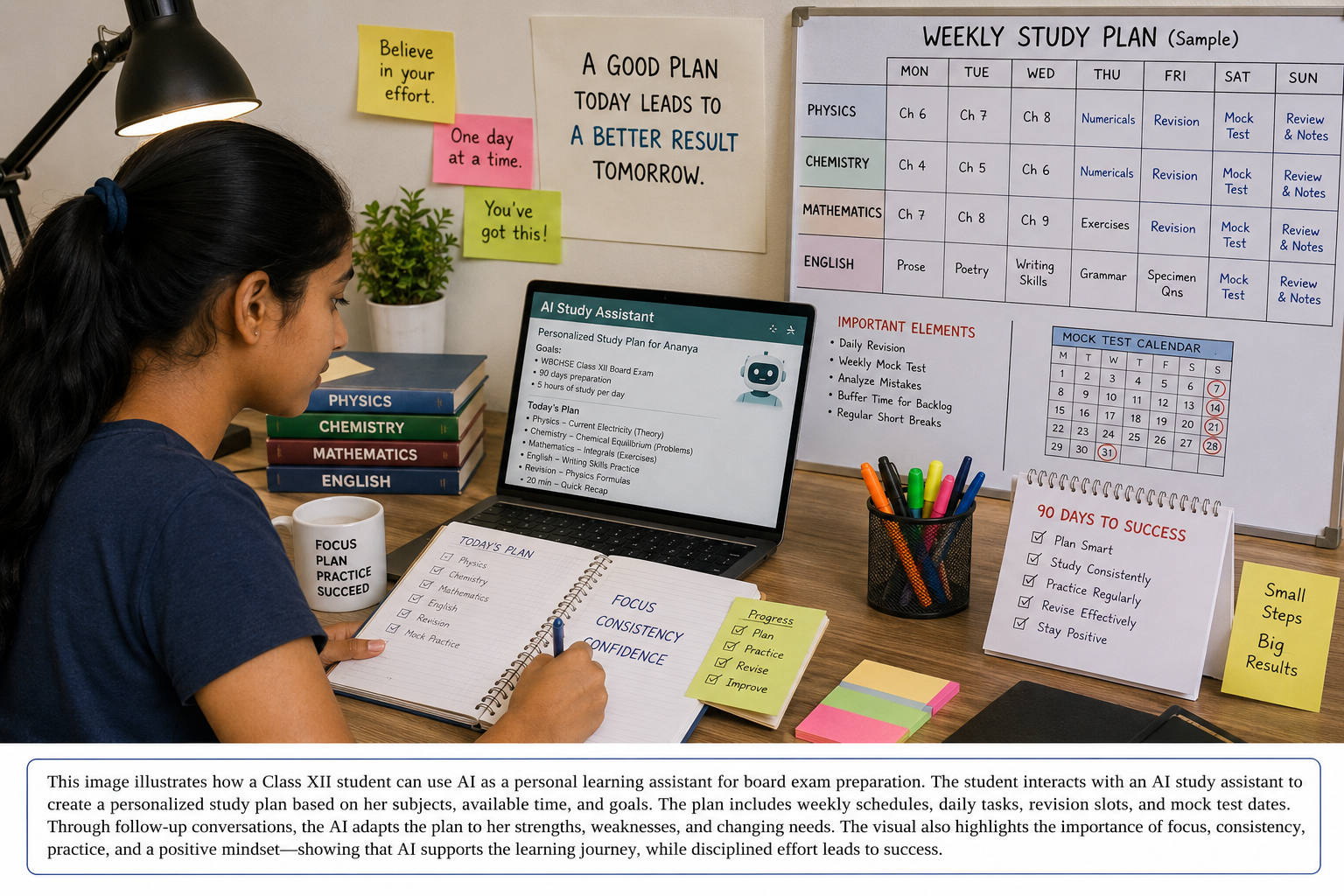
Only 90 days remain before the Board Examination. Ananya needs a realistic study plan that balances learning, revision, and practice while taking into account her strengths and weaknesses.
Example Prompt
“I am a Class XII WBCHSE student preparing for Physics, Chemistry, Mathematics, and English. I have 90 days left before my Board Examination and can study five hours every day. Please prepare a weekly study plan that balances learning, practice, revision, and mock tests.”
AI Interaction
The AI first generates a draft study plan, including:
Ananya can then refine this plan through a series of follow-up conversations. For example, she may tell the AI:
Based on this additional information, the AI continuously adapts and personalizes the study plan to better suit her individual needs and changing circumstances.
Benefit
Instead of following a generic timetable, Ananya receives a dynamic and personalized study plan that evolves with her progress. This not only reduces anxiety but also helps her use her study time more effectively and stay motivated throughout her preparation.
Situation
Chemical Equilibrium feels confusing.
Example Prompt
Explain Chemical Equilibrium as if you are teaching a Class XII student. Use simple language, everyday examples, diagrams and useful YouTube videos. Then ask me three questions to check my understanding.
AI Output
Ananya then refine her understanding through a series of follow-up conversations with AI.
Benefit
Learning becomes conversational rather than passive.
Situation
Ananya needs realistic practice.
Example Prompt
Create ten WBCHSE-style Chemistry questions on Electrochemistry. Include a mix of MCQs, short-answer and long-answer questions. Do not provide the answers until I attempt them.
AI Output
Benefit
Students receive unlimited practice tailored to their needs. Student refine her understanding through a series of follow-up interactions with AI.
Situation
The examination is only seven days away.
Example Prompt
Summarize the complete Class XII Biology chapter “Genetics and Evolution” into two pages containing formulas, important concepts, common mistakes and probable examination questions.
AI Output
Benefit
Revision becomes focused instead of repetitive.
Situation
The night before the examination. Ananya feels nervous.
Example Prompt
I have prepared reasonably well but I am anxious about tomorrow’s examination. Please help me calm down and suggest a practical study plan for the remaining evening.
AI Output
AI suggests
Benefit
AI supports emotional readiness as well as academic preparation.
The real value of AI is not obtaining quick answers. It is developing new learning capabilities. For example, students gradually learn how to
These capabilities remain valuable long after the Board Examination.
AI is a powerful learning assistant—but it has important limitations.
AI cannot:
Students should always:
Responsible AI use means treating AI as a guide—not an unquestionable authority.
This example illustrates a broader shift taking place in education.
For decades, educational technology focused primarily on delivering information.
Generative AI represents a different possibility: personalized learning conversations that adapt to the learner’s questions, pace, and needs.
The real educational transformation therefore lies not in replacing teachers, but in augmenting every student’s ability to learn independently.
This perspective aligns with the emerging concept of AI Capability Development (AICD)—developing the knowledge, skills, judgment, and confidence required to work effectively with AI throughout one’s educational and professional life.
Rather than teaching students a collection of AI tools, educators should help them build enduring capabilities that remain valuable even as technologies continue to evolve.
Yes. AI tools such as ChatGPT can help students plan their studies, understand difficult concepts, generate practice questions, revise efficiently, and improve learning. However, they should complement—not replace—textbooks and teachers.
AI is helpful but not infallible. Students should verify important facts, formulas, and numerical answers using official textbooks and guidance from teachers.
There is no single “best” tool. What matters more is learning how to use AI purposefully based on individual learning needs.
AI cannot guarantee better marks. It can, however, improve planning, understanding, practice, and revision, which may contribute to improved academic performance when combined with disciplined study.
Not necessarily. When used responsibly, AI encourages students to ask better questions, think critically, and become more independent learners rather than passive recipients of information.
Parents should encourage balanced AI use, discuss AI-generated responses with their children, promote verification from reliable sources, and ensure that AI supplements rather than replaces genuine learning.