

“How do I reduce my child’s screen time?”
“How much screen time is too much?”
“Is social media harming my child?”
These are among the most common concerns today.
And understandably so.
Research shows that excessive digital engagement can affect children’s well-being—impacting sleep, anxiety, and overall life satisfaction.
But the question is:
👉 Are we asking the right question?
Most discussions focus on:
👉 How many hours?
But rarely on:
👉 What kind of engagement?
There is a fundamental difference between:
Treating all screen time as equal oversimplifies the issue.
Many parents try:
These may work temporarily.
But over time:
Why?
Because the underlying issue remains unaddressed:
👉 the relationship between the child and the digital world
Instead of asking:
❌ “How do I reduce screen time?”
You may ask:
👉 “How does my child engage with the digital world?”
This shifts focus from:
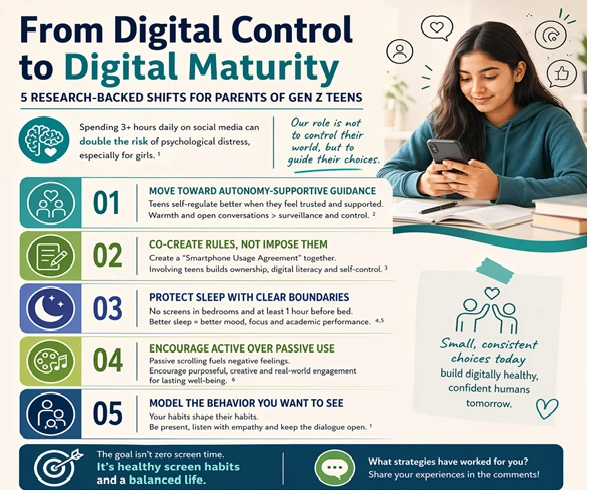
In today’s context, parenting cannot be limited to:
👉 controlling exposure
It must evolve toward:
👉 building digital maturity
This includes helping children:
Children today are not just users of technology.
They are growing up within it.
So the goal is not to eliminate screens—but to help them:
✔ develop judgment
✔ build self-regulation
✔ engage meaningfully
Research even shows that digital environments can support learning and social interaction when used constructively.
From a broader life design viewpoint, the issue is not “screen time.”
It is:
👉 how children design their attention, habits, and daily lives
This requires:
—not just rules.
Instead of reacting to screens as a threat:
👉 parents can begin to design a healthier relationship between:
You cannot fully remove screens from your child’s life.
But you can help them to use with awareness